Introduction
What if you could wake up tomorrow morning, spend two hours on your laptop, and have a new stream of income running by the end of the day with no artistic training, no expensive equipment, and no startup costs?
Thank you for reading this post, don't forget to subscribe!That is not a fantasy in 2026. That is exactly what thousands of Americans are doing right now by selling AI-generated art online.
AI art has moved from being a curious technology experiment to a legitimate, growing market. People are buying AI-generated prints for their homes, using AI artwork for their businesses, downloading AI graphics for their presentations, and wearing AI-designed patterns on their clothing. The demand is real. The market is expanding. And the barrier to entry has never been lower.
But here is what most beginner guides will not tell you: simply generating pretty images and uploading them to a marketplace is not enough to make consistent money. The people actually earning significant income from AI art are approaching it with strategy, market awareness, and a genuine understanding of what buyers want not just what the AI can produce.
This guide gives you the complete, honest roadmap. We cover every proven method for selling AI art online, the platforms that pay best, how to price your work, the legal realities you need to understand, and the exact mistakes that cause most beginners to give up before they see their first dollar.
Whether you want to earn an extra few hundred dollars a month on the side or build a full-time AI art business everything you need to know is right here.
Section 1 Understanding the AI Art Market in 2026
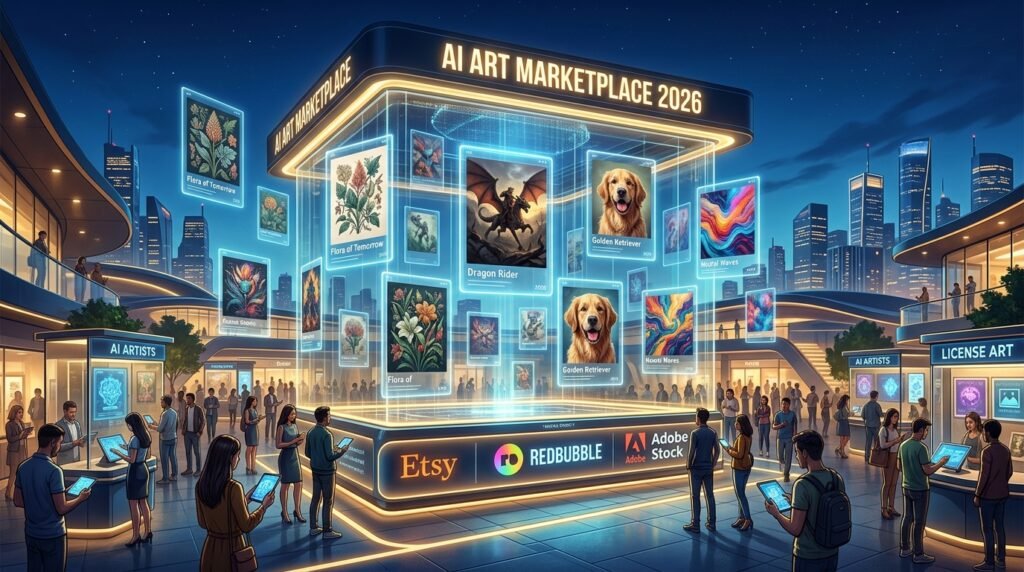
Why People Are Buying AI Art
Before you can sell anything successfully, you need to understand why people buy it. AI art buyers in 2026 fall into several distinct categories, and knowing which category you are serving changes everything about how you create and market your work.
Home Decor Buyers are the largest category. Millions of Americans buy wall art prints every year for their homes, offices, and rental properties. They want beautiful, affordable, unique artwork that matches their interior aesthetic. They are not buying a famous painting — they are buying something that looks great on their wall at a price that does not hurt their wallet. AI art serves this market perfectly because it can produce beautiful, original images at a fraction of the cost of commissioned artwork.
Small Business Owners represent the fastest-growing buyer category. They need images for their websites, social media accounts, marketing materials, product packaging, and presentations. Stock photography is expensive and generic. Custom commissioned artwork takes weeks and costs hundreds of dollars. AI-generated images that are commercially licensed and visually distinctive are exactly what this market needs.
Content Creators and Bloggers buy AI-generated images constantly for article headers, YouTube thumbnails, podcast cover art, and newsletter graphics. They need fresh, unique visuals on a continuous basis and cannot afford to commission custom work for every piece of content.
Gift Buyers are a surprisingly large market. Personalized AI art prints, custom pet portraits in artistic styles, and unique themed artwork make genuinely popular gifts. The ability to generate something that feels personal and distinctive at an affordable price point drives strong sales in this category throughout the year.
What Is Actually Selling in 2026
Not all AI art sells equally well. Here is an honest picture of what buyers are actually spending money on right now in the USA market.
Botanical and nature-themed prints continue to be the strongest-selling category for home decor. Minimalist landscapes, wildflower illustrations, abstract nature patterns, and stylized plant artwork consistently top the bestseller lists on platforms like Etsy and Society6.
Dark and moody fantasy art sells strongly to a passionate niche audience gamers, science fiction readers, tabletop RPG players, and fantasy genre enthusiasts who want artwork that reflects their interests. This niche is competitive but has dedicated buyers who purchase repeatedly.
Motivational and inspirational quote artwork with beautiful AI-generated backgrounds remains one of the highest-engagement categories on print-on-demand platforms. The combination of meaningful text with stunning imagery drives strong emotional purchase decisions.
Pet breed specific artwork is a perennial bestseller that never goes out of style. Golden retriever portraits, cat breed illustrations, custom pet paintings in various artistic styles pet owners are passionate buyers who return repeatedly and share their purchases enthusiastically.
Abstract art in sophisticated color palettes sells well to design-conscious buyers furnishing modern homes and offices. Clean geometric abstracts, fluid color pour aesthetics, and minimalist compositions with confident color choices perform consistently across all major platforms.
The Reality About Competition
Yes, more people are creating and selling AI art than ever before. But the market is also larger than it has ever been. The creators who are struggling are those uploading hundreds of generic, low-effort images without any niche focus or marketing strategy. The creators who are thriving are those who serve a specific audience, maintain consistent quality standards, and treat their AI art as a real business with real marketing.
The opportunity is genuinely large enough for thousands of new creators to build profitable AI art businesses in 2026 as long as they approach it strategically.
Section 2 The 7 Best Ways to Sell AI Art Online
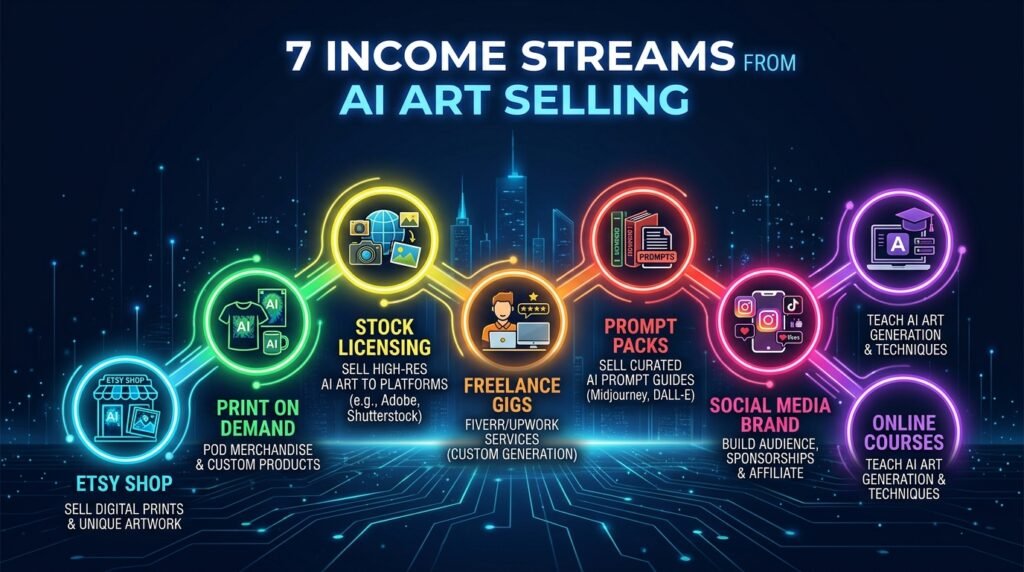
① Selling Digital Downloads on Etsy
Etsy remains the single most effective starting point for AI art sellers in 2026. With over ninety million active buyers searching for unique, creative products every month, Etsy provides immediate access to a massive audience of people who are already in a buying mindset.
The digital download model is particularly attractive for AI art. You create an image once, list it as a digital file that buyers download immediately after purchase, and earn money repeatedly from that single piece of work with zero additional effort. There is no printing, no shipping, no inventory, and no customer service headaches beyond the occasional download issue.
The economics are straightforward. Etsy charges twenty cents to list each product and takes six and a half percent of each sale. On a ten-dollar digital download, you keep approximately nine dollars after fees. Sell that same download a hundred times and you have earned nine hundred dollars from a single image you spent ten minutes creating.
The key to success on Etsy is treating your listings like search engine results. Your title, tags, and description need to include the exact words buyers are searching for. Instead of titling your image “Beautiful Botanical Print,” use “Vintage Botanical Print Set of 4, Wildflower Wall Art, Farmhouse Decor, Printable Download, Living Room Art.” Every word in that title is something a buyer might actually search.
Creating sets and collections dramatically outperforms selling individual images. A set of four coordinating prints sells three to five times better than four individual prints at the same total price because buyers see more value, easier decision-making, and a cohesive aesthetic they can immediately envision in their space.
② Print-on-Demand Merchandise
Print-on-demand platforms are the other essential income stream for AI art sellers. These platforms print your AI designs onto physical products t-shirts, hoodies, mugs, tote bags, phone cases, throw pillows, notebooks, wall canvases, shower curtains, and hundreds of other items only when a customer orders. You never handle inventory, never ship anything, and never deal with production logistics.
Redbubble, Society6, Merch by Amazon, Teepublic, and Zazzle are the five most important platforms for AI art print-on-demand in 2026. Each has different strengths and different customer bases, and listing your designs on multiple platforms simultaneously multiplies your exposure with no additional work.
The margins on print-on-demand are lower than digital downloads — typically earning five to twenty dollars per product sold depending on the item and platform. But the passive income model is compelling. Once your designs are uploaded, sales happen around the clock without any ongoing effort from you.
Niche focus is the single most important factor in print-on-demand success. Generic designs compete against millions of other listings. Specific niche designs — golden retriever mom coffee mug, emergency nurse life t-shirt, mountain hiking motivational hoodie — face far less competition and convert at dramatically higher rates because they speak directly to a specific buyer’s identity.
③ Licensing AI Art to Businesses
Licensing is the highest-income opportunity for AI art sellers who are willing to move beyond consumer marketplaces. Businesses need visual content constantly for their websites, marketing materials, product packaging, social media accounts, email campaigns, and internal presentations. And they will pay significantly more for licensed commercial imagery than individual consumers pay for prints.
Adobe Stock, Shutterstock, Getty Images, and Alamy all accept AI-generated images with proper disclosure. When a business downloads your image from a stock platform, you earn a royalty. Upload enough high-quality, commercially relevant images and these royalties accumulate into meaningful passive income.
The approach to stock photo success with AI art is different from selling prints. Stock buyers need clean, professionally composed images that solve specific visual communication needs. A beautiful fantasy landscape might sell well as a print but has limited stock photography value. A clean, professionally styled image of a diverse team having a meeting, a close-up of hands using a smartphone, or a beautifully lit food photography concept has high stock value because thousands of businesses need exactly that kind of image.
Building a stock portfolio requires volume. Professional stock photographers upload hundreds or thousands of images before seeing significant royalty income. The same applies to AI art stock submissions success comes from building a large, diverse portfolio of commercially relevant images over time.
④ Selling Custom AI Art Services on Fiverr and Upwork
Many individuals and businesses want custom AI-generated artwork personalized to their specific needs but lack the knowledge, skills, or tools to create it themselves. Selling your AI art creation skills as a service allows you to earn active income on top of any passive income from print and digital sales.
The most profitable custom AI art services include personalized pet portraits in various artistic styles, custom book cover designs for self-published authors, social media content packages for small business owners, personalized birthday and wedding gifts, and game character or fantasy avatar creation.
Fiverr is the best platform to start offering these services. Create a clear gig with specific deliverables — for example, “I will create three custom AI art portraits of your pet in watercolor style, delivered as high-resolution files within 24 hours.” Price your initial gigs competitively to build reviews, then raise your rates as your reputation grows.
The key insight about service selling is that clients are paying for your expertise, your time, and your ability to deliver exactly what they want — not just for the AI generation itself. The best custom AI art service providers excel at understanding client needs, communicating clearly about what is achievable, and refining images through multiple iterations until the client is thrilled.
⑤ Selling AI Art Prompt Packs
This is one of the most underutilized but genuinely profitable opportunities in the AI art space. There is a massive community of people who use AI art generators regularly but struggle to write prompts that produce consistently beautiful results. These people will pay real money for proven, high-quality prompts that they can use immediately.
A prompt pack is simply a digital product sold as a PDF or text file containing a curated collection of detailed, tested prompts that produce specific types of beautiful images. A pack of fifty proven prompts for generating fantasy character art, botanical illustration, photorealistic portraits, or any other specific style can sell for ten to fifty dollars as a digital download.
PromptBase is a specialized marketplace specifically for buying and selling AI prompts, with a built-in audience actively looking for prompts to purchase. Etsy and Gumroad are also effective platforms for selling prompt packs to a broader creative audience.
Building prompt packs requires genuine expertise you need to have spent significant time learning what works and what does not in your chosen style niche. But once you have that expertise, packaging it into a sellable product is straightforward and the product sells indefinitely with no ongoing work.
⑥ Building a Niche AI Art Brand on Social Media
Growing a focused social media account around a specific AI art niche creates multiple income opportunities simultaneously brand sponsorships, affiliate marketing, driving traffic to your Etsy store, and eventually selling your own courses and products to an engaged audience.
The key word here is niche. An Instagram account called “AI Art” with random images in every possible style will never build a loyal following. An account called something specific a gothic dark fantasy art account, a cozy cottagecore illustration account, a minimalist architectural AI art account builds a recognizable brand that attracts a dedicated audience who specifically loves that aesthetic.
Pinterest deserves special mention as a traffic driver for AI art sellers. Pinterest is still the number one source of referral traffic for Etsy shops in 2026, and AI art performs exceptionally well on the platform because it is visually driven, discovery-oriented, and reaches buyers actively planning purchases. Consistently pinning your AI art images particularly home decor, fashion, and lifestyle content drives free organic traffic to your Etsy and Redbubble stores indefinitely.
⑦ Creating and Selling AI Art Courses and Tutorials
Once you develop genuine expertise in AI art creation, teaching others is one of the highest-income paths available. Online courses, YouTube tutorials, paid newsletters, and membership communities around AI art have enormous and growing demand.
Udemy, Skillshare, Teachable, and Gumroad are the main platforms for selling AI art courses. A well-structured course on a specific topic — how to create consistent character art with Leonardo AI, how to build a profitable AI art Etsy shop, or how to master prompt engineering for photorealistic images — can sell for thirty to two hundred dollars and continue generating income for years after creation.
YouTube tutorials build an audience and generate advertising revenue while simultaneously establishing your authority and driving students toward your paid courses. The creators who combine free YouTube content with paid course offerings build the most sustainable long-term income from the AI art education space.
Section 3 The Best Free Tools for Selling AI Art
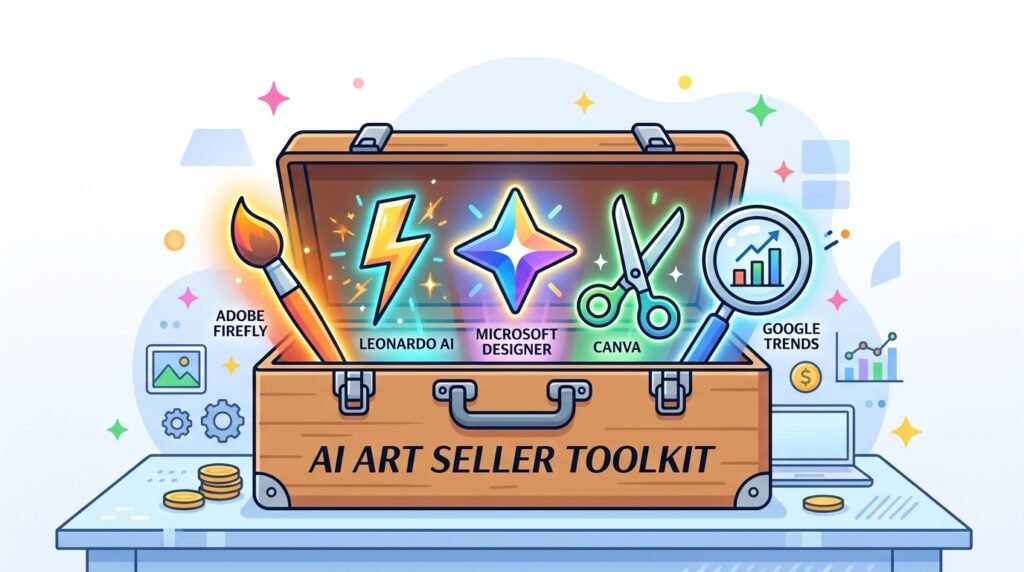
You do not need to spend money to start. Here is a complete breakdown of the best free tools at every stage of the process.
Image Generation Tools
Adobe Firefly at firefly.adobe.com is the most important free tool for anyone planning to sell AI art. The reason is commercial licensing — Adobe trained Firefly exclusively on licensed Adobe Stock content, which means every image you generate is legally safe to sell commercially. The free plan gives twenty-five monthly credits. For selling purposes, this is the tool you should prioritize.
Leonardo AI at leonardo.ai offers the most generous free plan with approximately one hundred fifty daily tokens roughly thirty to fifty images per day. The artistic quality is excellent and the wide model selection allows you to develop distinctive visual styles that stand out in marketplaces. This is the best free tool for volume creation and artistic style development.
Microsoft Designer powered by DALL·E 3 delivers top-tier image quality completely free with a Microsoft account. The images are commercially usable and the quality is consistently impressive across a wide range of subject matter and styles.
Ideogram AI is the essential free tool for any seller creating quote art, poster designs, or any product that requires readable text integrated into the image. The free plan offers ten daily generations.
Design and Editing Tools
Canva Free is essential for adding professional finishing touches to your AI-generated images before listing them adding watermarks to previews, creating product mockups, designing listing graphics, and preparing images in the exact dimensions each platform requires.
Upscayl is a free desktop application that increases the resolution of your AI-generated images to print quality using AI upscaling technology. Most AI generators produce images at resolutions suitable for screens but not always for large prints. Upscayl solves this problem completely and for free.
Remove.bg removes backgrounds from images for free useful for creating product mockups and transparent-background design files that command higher prices on certain platforms.
Business Tools
Google Trends is completely free and invaluable for researching what art themes, styles, and subjects are trending before you invest time creating them. Generating images that align with rising trends dramatically improves your initial sales velocity.
Erank or Marmalead offer free tiers for Etsy SEO research helping you identify exactly which keywords buyers use when searching for art similar to yours, which is the difference between listings that get found and listings that sit invisible.
Section 4 Legal and Copyright Reality for AI Art Sellers
This section is the one most beginners skip and it is the most important one to read carefully before you make your first sale.
Can You Legally Sell AI-Generated Art?
The short answer is yes, with important nuances. US law does not automatically grant copyright to purely AI-generated images, but the more human creative input that goes into the process — through prompt crafting, image selection, editing, and arrangement the stronger your claim to the work. The US Copyright Office has granted copyright protection to AI-assisted works where significant human creative decisions are demonstrably involved.
For practical purposes, most AI art sellers operate without active copyright claims against them. The real legal considerations are about which tool you use and what its terms of service permit for commercial use.
The Commercial Use Tool Guide
Adobe Firefly is the gold standard for commercial AI art selling. Adobe explicitly states that Firefly-generated images carry commercial use rights and backs this with IP indemnification meaning Adobe takes legal responsibility if copyright disputes arise from their tool. For anything you plan to sell, Firefly is the safest choice.
Microsoft Designer powered by DALL·E 3 also allows commercial use under OpenAI’s current terms, making it a safe second option for commercial selling.
Leonardo AI’s free plan has more restrictive commercial terms. Upgrading to a paid plan unlocks full commercial use rights.
Midjourney allows commercial use on paid plans but not on any free tier.
Disclosure Requirements
Major selling platforms are increasingly requiring sellers to disclose when products contain AI-generated content. Etsy added an AI disclosure requirement in 2024, and Adobe Stock requires AI disclosure on all submissions. Being transparent about your process is both ethically right and practically necessary attempting to hide AI origins is increasingly detectable and can result in account suspension and permanent bans.
Avoiding Copyright Problems
Never prompt AI generators using the names of specific living artists with the intent to replicate their style for commercial sale. Never generate images of recognizable real people or celebrities. Never reproduce elements of specific copyrighted artworks. Stick to general style descriptions, original concepts, and non-infringing subjects and you will avoid the vast majority of potential legal issues.
Section 5 Pros and Cons of Selling AI Art Online
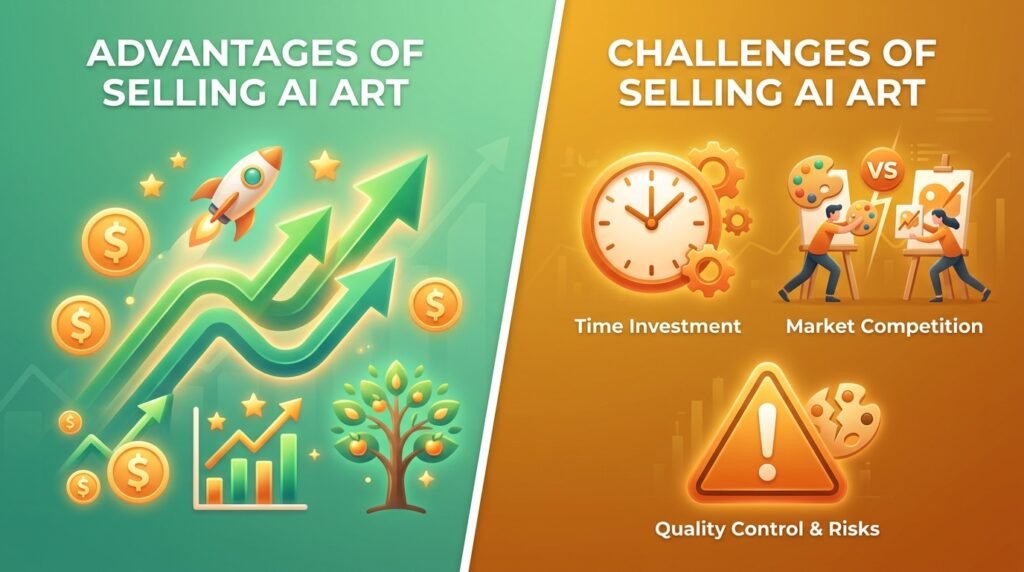
The Real Advantages
Zero Startup Cost is the most compelling entry point. You can begin your AI art selling business with completely free tools, free platform accounts, and no inventory investment whatsoever. The only resource you invest initially is time and time spent learning pays dividends indefinitely.
Genuine Passive Income Potential is not marketing hype in this context. Digital downloads on Etsy and designs on print-on-demand platforms genuinely generate income while you sleep, travel, or work your day job. A portfolio of fifty well-optimized digital art listings can generate hundreds of dollars per month with zero ongoing effort beyond the initial creation and listing work.
Unlimited Scalability distinguishes AI art selling from traditional art businesses. A human painter can create perhaps one to five finished pieces per week. With AI tools, you can create and list dozens of images per day building a portfolio at a speed that is simply impossible through traditional means. More listings mean more discoverability, more sales, and more income.
No Artistic Skill Barrier removes the traditional gatekeeping that kept most people out of art selling. The skill that matters in AI art selling is not hand-eye coordination, color theory, or years of technical practice it is creative thinking, market awareness, effective prompt writing, and smart business decisions. These are skills anyone can develop.
Low Ongoing Risk means that if a particular niche or style is not selling, you have lost nothing but time. You can pivot completely, try an entirely different approach, or test multiple niches simultaneously without any sunk financial cost.
Location and Time Independence make AI art selling one of the genuinely flexible income sources available. Everything creation, listing, optimization, marketing can be done from anywhere with an internet connection, on whatever schedule fits your life.
The Honest Challenges
The Market Is Getting More Competitive every month. The creators who entered two years ago had a significant first-mover advantage. New entrants in 2026 need to work smarter with better niche focus, stronger SEO, more consistent quality, and more strategic marketing to achieve comparable results.
Income Takes Time to Build is the reality that most get-rich-quick presentations about AI art selling deliberately obscure. Building a Etsy shop with meaningful monthly income typically takes three to six months of consistent work. The passive income that people talk about is real — but it is preceded by months of active work building the portfolio and learning the platform.
Platform Policy Changes Create Risk for any business built on a third-party marketplace. Etsy, Redbubble, and Adobe Stock all have the power to change their AI content policies, commission structures, or terms of service at any time. Diversifying across multiple platforms reduces but does not eliminate this risk.
Legal Clarity Is Still Evolving in ways that could affect AI art sellers. Copyright law, disclosure requirements, and platform policies around AI-generated content continue to develop. Sellers need to stay informed and be prepared to adapt their practices as the legal environment clarifies.
Quality Differentiation Requires Genuine Skill even with powerful AI tools. Generating truly sellable images consistently images that buyers find compelling, that photograph well in mockups, that work across different product types requires developing real expertise in prompt engineering, aesthetic judgment, and market research. This takes real time and practice.
Platform Fees Reduce Margins meaningfully on lower-priced products. Etsy’s combined fees listing fee, transaction fee, and payment processing take approximately fifteen percent of each sale plus twenty cents per listing renewal. Print-on-demand margins are thin on lower-priced items. Pricing strategy matters significantly for profitability.
Conclusion
Selling AI art online is one of the most accessible legitimate side income opportunities available to Americans in 2026. The tools are free. The platforms are open to anyone. The market is real and growing. And the potential for genuinely passive income from digital products and print-on-demand is not theoretical it is happening for thousands of creators right now.
The path to success is clear. Start with Adobe Firefly and Leonardo AI for free image creation. Choose one specific niche not “all art,” but something specific like botanical home decor prints, or dark fantasy merchandise, or pet breed portrait downloads. Build a portfolio of at least twenty to thirty high-quality, cohesive images in that niche. List them on Etsy as digital downloads and on Redbubble as print-on-demand products simultaneously. Optimize every listing with keyword-rich titles, detailed descriptions, and relevant tags. Pin everything to Pinterest consistently. Analyze what sells and create more of it.
The creators who fail at selling AI art are those who create randomly, list without strategy, optimize nothing, and give up after two weeks when sales do not appear instantly. The creators who succeed treat it like a real business with consistent effort, data-driven decisions, and the patience to let a growing portfolio generate compounding income over time.
Your first sale is closer than you think. Your first hundred dollars is achievable within weeks. And your first thousand-dollar month is entirely possible within six months of consistent, strategic effort.
The only step between you and that outcome is deciding to start.
Frequently Asked Questions
Is it legal to sell AI-generated art in the USA?
Yes, selling AI-generated art is legal in the USA. The key requirement is using tools with commercial use rights Adobe Firefly is the safest option and properly disclosing AI-generated content on platforms that require it. Copyright ownership of purely AI-generated images remains a developing area of law, but selling AI art is not prohibited.
How much money can I realistically make selling AI art?
Beginners with consistent effort typically earn fifty to three hundred dollars per month in their first three months. With six months of strategic work across multiple income streams digital downloads, print-on-demand, and stock licensing — five hundred to two thousand dollars per month is achievable. Full-time dedicated sellers with established portfolios earn three thousand to ten thousand dollars or more monthly.
Which platform is best to start selling AI art as a complete beginner?
Etsy is the best starting platform for beginners because it has the largest buyer base for digital art downloads, a relatively straightforward listing process, and strong discoverability through its internal search engine. Redbubble is the best second platform because it requires zero additional work beyond uploading your designs.
Do I need to tell buyers that my art is AI-generated?
Yes — on most major platforms this disclosure is now required, not optional. Etsy requires AI disclosure in listings. Adobe Stock requires disclosure on all AI-generated submissions. Beyond platform requirements, transparency builds customer trust and protects your long-term reputation.
What is the best AI tool for creating art to sell?
Adobe Firefly is the best tool specifically for commercial selling because of its explicit commercial use rights and licensed training data. Leonardo AI is the best free tool for artistic quality and volume generation. Microsoft Designer powered by DALL·E 3 is the best free option for photorealistic and commercially styled images.
Can I sell AI art on Amazon?
Yes, through Merch by Amazon Amazon’s print-on-demand platform that puts your AI designs on t-shirts, hoodies, and other products available to Amazon’s massive customer base. Merch by Amazon has an application process, but once accepted, it provides access to one of the largest retail audiences in the world.
How long does it take to make my first sale?
Most sellers with well-optimized listings on Etsy make their first sale within two to four weeks. The timeline depends heavily on listing quality, keyword optimization, and whether you are actively driving traffic from Pinterest or social media. Accounts with strong SEO in specific niches often see their first sales within days.
Do I need a business license to sell AI art online?
For small-scale selling as a hobby income, a business license is generally not required in most US states. Once your income becomes consistent and meaningful, registering as a sole proprietor or LLC provides legal protection and tax advantages. Regardless of income level, you are required to report all income from AI art sales on your federal tax return consult a tax professional about your specific situation.
What is the best niche for selling AI art in 2026?
The consistently strongest-selling niches for AI art in 2026 include botanical and nature home decor prints, dark fantasy and gothic art, pet breed portraits and merchandise, motivational quote artwork, minimalist abstract prints, and cottagecore aesthetic illustrations. The best niche for you personally is the one where you can create the most distinctive, highest-quality work with genuine enthusiasm.
Can I use ChatGPT to help me write my Etsy listings?
Absolutely and you should. ChatGPT is excellent for writing keyword-rich Etsy listing titles, crafting compelling product descriptions, generating relevant tags, and creating Pinterest descriptions for your images. Many successful AI art sellers use ChatGPT specifically for their listing copywriting, which frees their time to focus on image creation and business strategy.